News
At what age should my child stop wetting the bed?
There is no magic age for determining when bedwetting is a problem. Many refer to 6-7 years of age as when a parent needs to address the problem. After this age often concerns begin to arise. Around 70% of children stop wetting the bed at night by the time they reach 5-6 yrs of age. By around age 7-8 there are around 8-15% of children who still wet their bed. If your child is over the age of 5 ½ and is still wetting the bed at night, they may well grow out of it in time, however if your child complains about wetting the bed, feels uncomfortable about it or begins to show embarrassment or self-esteem issues, then now is the time to help your child become dry at night. Learn more about bedwetting solutions
Learn moreHELP! My child is still having accidents during the day...
Do you spot your child with a sudden look of panic on their face, one leg on top of the other in a ‘curtsy’ position, holding on for dear life? Chances are they have realised, too late, that they need to ‘go’. Daytime accidental wetting is much less common than bed-wetting. But about 1 out of 4 children who wet the bed at night also wet during the day. If your child is having accidents during the day, your first course of action is to visit your doctor. Once you have determined that no medical issues are the reason behind the wetting, then a good course of action is to start ‘timed toilet trips’ throughout the day. Here are some suggestions for implementing a ‘timed voiding’ schedule for your child: Keep a diary to record wetting accidents during the day and night, then look for patterns. Do accidents tend to occur at the same times? Does it look like they could be related to meal times? Can you identify any stress triggers? Encourage your child to drink plenty of water throughout the day. Aim for 6-8 glasses of water per day and avoid fizzy or caffeinated drinks. Remember drinking less does not help. With a fuller bladder your child will be able to recognise the sensation to urinate easier. Think about how often your child may need to use the toilet and plan toilet trips around his schedule. Discuss bathroom breaks with caregivers and teachers to make sure the schedule is followed when your child isn’t at home. Visiting the toilet every 2½ to 3 hours should work best. Use a discreet timer to help remind your child when to go. Look for a vibrating reminder watch to suit your child’s needs. If using rewards/incentives these need to be for something your child has control over e.g. drinking well, using the toilet. Reward her for sitting on the toilet regardless of the result, as she may not be able to achieve dry pants initially. Encourage him to take time to empty his bladder fully. Some children are in such a hurry they do not completely empty their bladder. Use a timer, have a special book to read, sing a song, count to 10. Daytime accidents can be frustrating for you and your child. By having a manageable plan in place you should be able to tackle the problem together.
Learn more10 tips to combat bedwetting…
Bedwetting can be hugely challenging, both for parents and their bedwetting child. The daily workload of washing sheets and pyjamas, the efforts to keep bedding and mattresses free from urine and not to forget the frustration and often embarrassment caused from wetting the bed night after night. Remember, you are not alone. Although often not talked about, bedwetting is common amongst 5 and 6 year olds and up to 30% of this age group still wet their bed. Children reach milestones at different ages in their life and learning to control their bladder at night is another developmental milestone. Bedwetting is often hereditary and despite how you may sometimes feel, bedwetting it not your child’s fault. Almost all children want to stop, but simply can’t. Here are some tips to help you and your child combat bedwetting once and for all: Increase daytime fluids and toilet visits. Research suggests that children who drink water throughout the day and visit the toilet regularly will improve their bladder health resulting in improved night time dryness. In simple terms teach your child how their bladder works. Encourage him to ‘take his time’ and relax on the toilet. Children who rush often don’t empty their bladder completely. Try not to offer incentives. Offering your child a new bike or toy to stop wetting the bed can result in frustration and disappointment. Encouraging your child is good, but don’t set him up to fail. If he could stop, he would stop. Don’t overly restrict drinks. While it is true that drinking too much before bed can contribute to wetting, it’s often not the cause of bedwetting. It’s a good idea to avoid fizzy or caffeinated drinks but don’t go overboard restricting fluids. Don’t lift your child to the toilet each night. Lifting is of little use, and may even prolong the problem. Your child has to get used to waking up when his bladder is full. Children often do not remember being lifted, and it usually does not help to achieve their own bladder control. Be prepared and encourage independence. Use a waterproof mattress protector on the bed and place a spare protector and set of pyjamas next to the bed. Teach her how to help with the covers and tell her where to put the wet covers and pyjamas. Avoid nappies or pull-ups. If you and your child are ready to address bedwetting, then avoid using nappies or pull-ups. He needs to feel the wetness in order to engage his brain to recognise the sensation to urinate. Don’t wait too long to address the problem. Many children simply grow out of bedwetting but if you get to the point where your child is frustrated or embarrassed, then take steps to address the problem. A bedwetting alarm is the mostly commonly-used solution to bedwetting. Ask for help. Coping with a child who wets the bed every night can be hard work. Although waiting lists can be long, there are bedwetting services where help is available. Alternatively do your own research and consider using a bedwetting alarm. For a FREE e-book on bedwetting email us now.
Learn moreChoosing the right bedwetting alarm
A recent study saw 66% improvement in children who used a bedwetting alarm for 2 weeks, verses only 4% for those who used nothing at all. Research into the bedwetting alarms shows an 80% success rate in committed children (and their caregivers). How does a bedwetting alarm work? Different alarms work in slightly different ways but essentially a sensor detects wetness, which then activates an alarm (which vibrates and/or sounds) to wake your child. Eventually the alarm conditions the brain to wake up before any accidents happen at all. The time is takes to ‘train the brain’ and stop wetting varies from child to child, but for some children they become dry within 10 days, other children can take much longer. Choosing the right bedwetting alarm There are three types of bedwetting alarms: #1 Wearable Bedwetting Alarms With a wearable alarm, the child places the moisture sensing device in his or her pyjamas or underwear (in the line of fire). When the child wets, the sensor detects the wetness and the alarm is sounded. The sensor is attached to a cord at one end and the alarm/unit at the other end. The unit attaches to the pyjama top. With this alarm your child will need to use a waterproof bed pad. Recommended: WetStop3 has been used successfully for over 40 years! It is a good cost-effective alarm. #2 Bed-and-Pad Bedwetting Alarm With an ‘alarm-and-pad’ bedwetting alarm, the moisture sensor is sewn into the pad placed beneath the sleeper. The sewn-in sensors in the pad detect moisture and the alarm sounds. The sensor pads which come with the Wet Detective from Potty MD have the added advantage of being waterproof, which means you don’t need an extra waterproof pad on the bed (as well as the sensor pad). The pads are also industrial quality so they withstand wash after wash. This is a good option for those children who don’t want to wear an alarm. They are also good for adults, the elderly and those with special needs. Recommended: Wet Detective #3 Wireless Bedwetting Alarm The third type of bedwetting alarm, the wireless alarm, is the newest technology on the market. The child wears special underpants (available in all sizes) which have sewn in sensors. The added advantage of this alarm over others is that moisture is detected immediately thereby triggering the alarm to sound immediately to wake the child. This alarm is comfortable to wear as no cords or cables are involved. A small transmitter is attached to the underpants and a base unit is plugged into a power point (or powered by battery). Another advantage of this alarm is that if you have a particularly deep sleeper or you have a child who shares a room, then a vibrating unit (Bed-Shaker) can be attached to this unit so vibration is used to wake your child. Lastly, a separate base unit can be purchased to place in the caregiver’s room so mum or dad can also hear the alarm sound. Recommended: Rodger Wireless Bedwetting Alarm Alarm Type Alarm Type Useful for Advantages Wet Stop 3 Wearable alarm with clipped on sensor and cord Sound and vibration Children Cost effective. Simple to use. Proven success (sold since 1979). Wet Detective Sensor pad on bed and alarm unit beside bed Sound Children Adults Special Needs Elderly Can be set to a loud setting. Pad is waterproof. Simple to use. Comfortable – no cables. Rodger Wireless Alarm Wearable sensor underpants with transmitter. Base unit plugged into wall. Sound Children Adults Special Needs Latest technology. Comfortable – sewn-in sensor underpants. No cords. Moisture detected immediately. Vibrating Bed Shaker attachment available. Second base unit for parent’s room available. Bedwetting alarms best practices Choose the right time. Choose times when routines are not interrupted too much. Talk to your child about how the alarm works and help him get prepared each night (spare pyjamas, night light, change of underpants/bed pad). Make setting the alarm part of your everyday bedtime routine. Do not skip nights. Be POSITIVE! Give plenty of encouragement and stay confident and positive along the way. Work on daytime toilet habits too. Encourage regular fluid and toilet stops throughout the day. Avoid using nappies or pull-ups—your child should feel the wetness. For some children it takes time before they wake to the sound of the alarm. Be patient & assist your child with waking when the alarm sounds. With time they will wake by themselves. Remain PATIENT throughout the process. Some children become dry within days, others take weeks. As you continue to use the alarm every night the number of dry nights will begin to outnumber the wet ones. However, during the training process, expect the occasional accident to occur. This is normal as your child’s body develops.
Learn moreVibrating Reminder Watch gets 5 stars
"Jacob is a busy boy, on the go all the time. He was about to start school and we were worried he would be too busy to remember to visit the toilet. At home he was still having the odd accident. We found this watch from Moose and set the vibrating alarm for morning tea time, lunchtime and afternoon tea time. It is working beautifully. Not one accident. He feels grown up wearing it and it functions really well. It also has a lock out feature so he can't mess with the settings. We like the idea that he is more independent with this watch. We don't have to rely on the teacher to tell him to go and we've started setting it when he is at home too (so we are nagging less). I have a friend who has a 10 year old child recently diagnosed with diabetes. She is going to purchase one to remind her child to take his blood sugar tests. Thanks for the watch Moose. We love it and give it 5 out of 5 stars." https://moosebaby.com.au/collections/wobl/products/wobl-vibrating-reminder-watch
Learn moreGertie gets a chomping good review
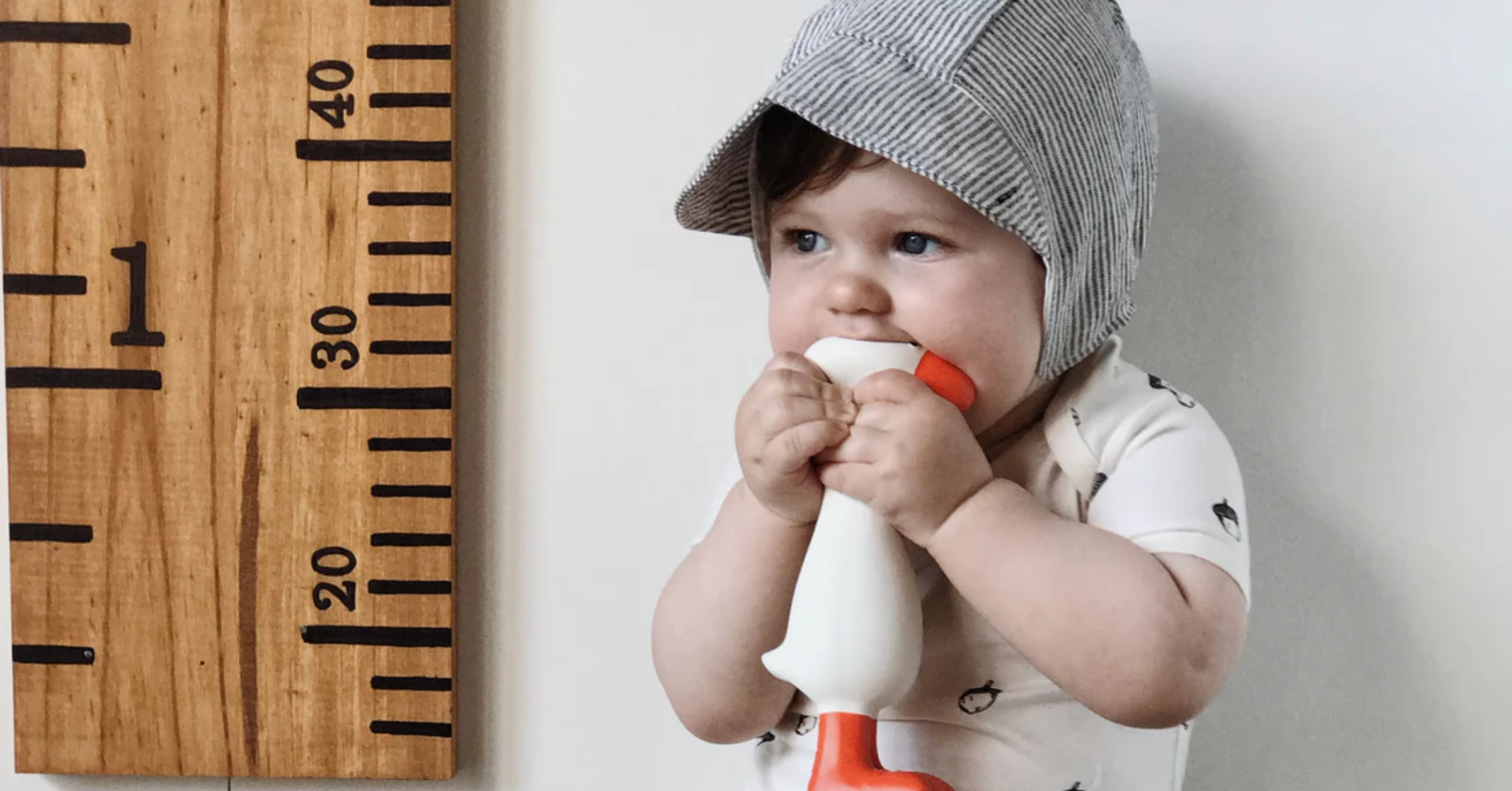
"With his two hands and a firm grip, he chomped down on Gertie’s beak, then after a while decided to turn him over to munch on the goose’s webbed feet." - Tika & Baby Brooks review Gertie the Good Goose. Read their full review here.... I love how easily Gertie fits in the hands of my eight month old son. He’s teething at the moment and as soon as his eyes met with Gertie’s contrasting white and orange colours (which is easier to spot for a baby who’s just discovering how to focus visually), he was in love. With his two hands and a firm grip, he chomped down on Gertie’s beak, then after a while decided to turn him over to munch on the goose’s webbed feet. Teething tears were soon wiped away and dried.....his teething pain soothed. Thanks Gertie!! Gertie’s smell was an instant treat. A soft vanilla scent filled my nose as I breathed in; a perfect example of what “natural” would smell like if natural was a scent. I love the classic and clean white look of Gertie. Very visually appealing, and smooth to the touch too: as smooth as river stones. When my son doesn’t have him, my daughter and I seem to gravitate towards him as well. A stress reliever for both young and old. The only improvement I would say is that Gertie needs more friends! I’m sure many families who love Gertie as much as we do would like to collection them all. We would most definitely recommend Gertie to a friend! Especially to the friend who wants the best teething tool to soothe their little one’s gums. And not only as a “treatment for teething” but also for a preventative piece. Gertie the Good Goose can also be a very good friend to little ones alike. Thanks again MOOSE for choosing us to review your amazing product! Tika Dew and Baby Brooks
Learn more